


PayBee vs Mightycause (2026): Features, Fees & the Best Fit for Your Fundraiser
TL;DR: PayBee or Mightycause?
If your searching for fundraising software to help with your charitable campaigns, PayBee and Mightycause are excellent choices. Mightycause is the more appealing choice for nonprofit institutions running community-style events, from crowdfunding pages to peer-to-peer campaigns year-round.
PayBee is the more event-focused alternative that specializes in things like live and silent auctions, galas, Fund-a-Need campaigns, livestreaming and general event management. The choice for you really depends on what kind of fundraising efforts matter most to your organization.
PayBee vs Mightycause: Side by Side
Each of these tools are valuable for fundraising teams; they just excel in slightly different spaces. Mightycause has more tools for peer-to-peer events and Giving Days, for instance, while PayBee gives you a lot of features for event management like mobile bidding and paddle raise tools, if you run annual galas or auctions. PayBee is also the option with its own ticketing solutions built-in, while Mightycause depends on an integration with Eventbrite.
What Is PayBee, and Who Is It Best For?
PayBee is an all-in-one fundraising platform designed to help nonprofits run and manage all kinds of events, from live and silent auctions to virtual galas with connected livestreaming capabilities.
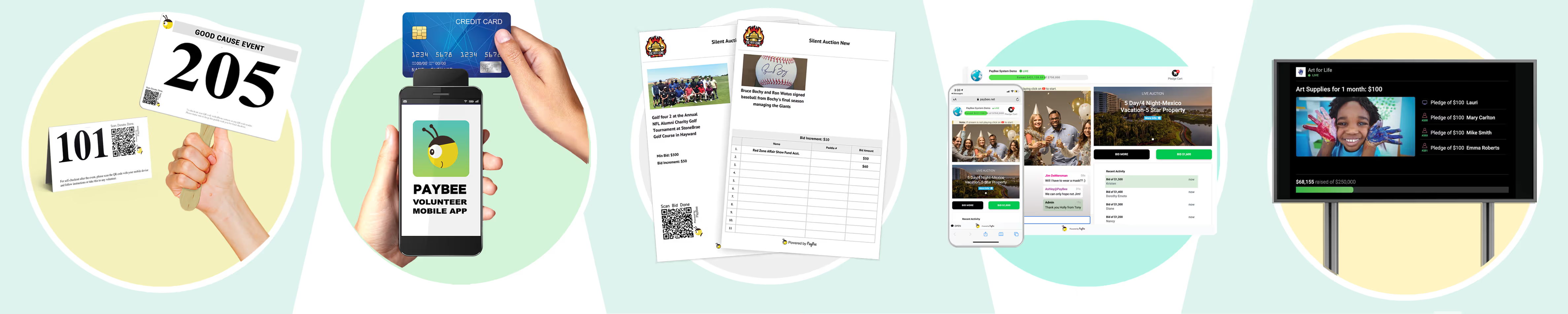
The toolkit covers everything from ticketing solutions to check-in management, Fund-a-Need solutions, paddle raise capabilities, recurring donations, and even real-time activity monitors.
You get a platform with guest records that can track ticket details, paddle numbers, table assignments, check-ins and meal choices automatically, plus mobile bidding and checkout solutions for auctions.
The event pages are excellent too, letting organizations add raffle tickets, auction previews, pledge campaigns, sponsor details and registration information on the same customized page. Every ticket links with the guest records, so people can buy online, add another donation, or pay at the door at a live event without setting anything up again.
All that, and PayBee helps organizations follow up with supporters after the event, too, with reporting and analytics tools, and email campaigns. It’s a great option for any organization that uses events as the main part of its fundraising strategy.
What Is Mightycause, and Is It the Same as Razoo?
Mightycause is also an excellent online fundraising platform, with built-in donor management capabilities, made to help organizations collect donations continuously throughout the year, often through donation pages and community-led campaigns.
It launched as “Razoo” in 2026, a platform mainly concentrating on crowdfunding solutions, then evolved into Mightycase in 2018, maintaining its peer-to-peer capabilities, as well as adding donation pages or embeddable widgets for websites, alongside other new features.
Although Mightycause hasn’t always had the best reputation for its built-in CRM, the donor management features have improved in recent years, giving teams access to donation history details, notes, email activity, P2P activity, and over 60 custom fields for sorting community members.
There’s also recurring giving available now, as well as text-to-give and matching gifts, plus, with the Eventbrite ticketing integration, organizations can manage ticket requirements, too.
If you’re a nonprofit that’s running several online campaigns throughout the year, Mightycause has a lot to offer.
How Much Do PayBee and Mightycause Cost in 2026?
Both platforms allow users to sign up without paying a monthly subscription fee, although there are other fees involved which can be a little confusing at first.
PayBee’s central online fundraising plan has no membership charge whatsoever, but the platform does charge a 2% fee on electronic transactions (other payments don’t incur a fee). There’s also the standard 2.7% plus 30 cents fee for cards, and a 1.3% for ACH payments.
The optional premium plans start at $599 for two years, with full support included, and on-site event support is also available for an extra fee. The premium plan also includes three card readers included for your events, although you can still use tap-to-pay with a standard phone.
Mightycause also doesn’t charge anything in terms of regular monthly subscription payments, but the fees are a bit more complicated. With the Price Guarantee option turned on, Mightycause asks donors whether they want to cover the standard charge of 7.9% plus $0.30 per transaction (payment processing fees are bundled into that price).
If the donor doesn’t pay, Mightycause can cap fees that might go above an average of 1.99% plus $0.49 per transaction before sending funds to the nonprofit. You can also turn donor fee coverage off entirely, which means that Mightycause deduces the full 7.9% plus 30 cent fee from each contribution.
One other thing worth mentioning is when the money reaches a nonprofit. PayBee batches transfers every day once the payments are finished processing, and card transactions take 2 to 5 days to arrive, while Mightycause sends ETF payments out twice per month.
PayBee vs Mightycause: Which Has the Better Fundraising Features?
It’s hard to declare an absolutely winner in terms of functionality, because both platforms have a lot of similar features and benefits. The main difference is that Mightycause is more focused on year-round giving and community strategies, while PayBee goes a lot further into event-based campaigns.
Online Donations And Recurring Giving
Both are pretty similar in this area. Mightycause gives teams a form builder that lets them control one-time and monthly giving options separately, set suggested amounts, add designated funds and dedication messages, answer FAQ questions, and preview while they edit. Once you have the form, you can embed it into your site. Mightycause supports plenty of payment options too, including options like PayPal, or Google Pay.
PayBee also has its own builder for donation pages, and can handle both one-time and recurring gifts, suggested amounts, QR code scans, digital wallets, as well as video hosting. It accepts most of the same payment types as Mightycause, and all of the donor details entered into a page are sent straight into the central contact record.
PayBee vs Mightycause: Crowdfunding, P2P and Giving Days
Mightycause has a bit more of an advantage with community events. You can bring individual and team fundraisers into the same campaign, and organizers can directly invite participants, track fundraising progress by page, message supporters, and download donor data. Teams can also record offline gifts, and assign them to specific fundraisers.
PayBee has peer-to-peer fundraising product too. Supporters get personal pages, charities can create team campaigns, and donations can run into shared goals or dynamic thermometers. With PayBee, users can also invite someone to create a personal fundraising page during an event registration, so you could encourage a supporter to start a 5K while they’re buying tickets for your next silent auction.
Mightycause is a little better for Giving Days though, thanks to branded Giving Day sites, participant management and registration tools, reporting, and gamified leaderboards.
Matching Gifts
The way these platforms approach matching gifts is a little different. With Mightycause, teams can create a matching grant that gets funded by a board member, local company, or another grantor. They can also choose the match ratio, and set minimum donation rules. Also, teams can schedule multiple matches and use them on event, fundraiser, or organization pages.
PayBee helps with employer matching strategies, letting donors search for their employer while they’re working through the donation process, and request a matching gift. Any gift that comes through gets logged in the donor’s history.
PayBee vs Mightycause: Ticketing and Registration
Ticketing and registration features are available with both tools, but PayBee is the better option for built-in functionality. You can create tickets within the PayBee platform, sell them through your donation page, and keep all the information (like seating details or paddle numbers) connected.
PayBee users can track group tickets, meal choices, and additional guest questions, too. Mightycause uses an Eventbrite integration for ticketing. Organizers can use that to create an Eventbrite registration and choose the types of tickets they want to offer.
Auctions, Fund-A-Need and Payment Collection
PayBee’s auction features handle scheduled opening and closing times, automatic bidding, minimum increments, QR bid sheets, Buy It Now options, and winner notifications. You can also ask bidders to save a payment method before they get started and send bulk charges after closing.
There’s also a catalog shortcut for nonprofit organizations using a lot of donated prizes, and in-kind donations collected through PayBee can move directly into your auction catalog. At live events, PayBee also has a paddle-raise tool, mobile bidding, dashboards for live totals, and Fund-a-Need support, too.
Mightycause doesn’t really have anything similar to offer, there aren’t any specific tools for live or silent auctions, mobile bidding, fund-a-need or paddle raises.
PayBee vs Mightycause: Mobile giving, Text-to-Give and Checkout
Mightycause has a traditional Text-to-give tool, which lets a nonprofit create a keyword that supporters need to send to a number to make a contribution.
On the other hand, PayBee uses text-to-donate links that open a mobile giving page, and it also supports QR giving, or donations through mobile wallet. There’s an optional mobile app available for collecting donations too, but guests can still bid and pay from any phone browser if they prefer.
There’s also Tap to Pay from PayBee, and a mobile checkout that lets volunteers check a guest’s cart, add or change items, and take payments.
Virtual and Hybrid Fundraising
Both platforms support digital giving, but PayBee is definitely better when you want to make the experience for remote and live supporters feel really connected. You can add a livestream next to auction and donation activity, so anyone watching from home can get see what’s happening at the venue.
Technically, Mightycause supports online participation around a physical fundraiser, mostly through P2P pages, but it doesn’t have any event check-in-check-out features, gala livestreaming options, mobile bidding, or paddle raise options.
PayBee vs Mightycause: CRM, Reporting and Integrations
Both tools have integrations with tools like Salesforce, and simple CRM-style features. With Mightycause, your contact page stores unlimited records with all the donation history, notes, email communications and peer-to-peer fundraising activity details you might need. There are also 60 fields for segmentation.
The reports are useful too, letting organizations filter transaction by campaign, amount, or gift type, and download full CSV data. You can also track recurring donations separately, and set specific permissions for users to determine which reports they should be able to access.
PayBee’s contact records collect all the same details you can assemble with Mightycause, and the records update automatically. The reporting tools are particularly good because the system knows all about the donor, guest, and transactions generated through each event.
Paybee vs Mightycause: Events, Galas, and Auctions
Mightycause is better when your event is built around community participants, with event pages that pull individual fundraisers and teams into one place, track details, and rank participants on leaderboards, but PayBee covers more of the full event process.
The event page can put ticketing options next to sponsors, pledge campaigns, silent auctions, raffle tickets, and live auction previews, and guest records can include tables, meal choices, paddle numbers, and check-in details.
During the event, PayBee can automatically assign paddles from the guest list, show live bids on a large screen, add winning bids to a guest’s cloud-based cart, and it supports mobile bidding. Fund-a-Need pledges can be added to the same guest cart, and volunteers can take payment through a mobile checkout at payment time, or let winners pay from their own phone. Mightycause doesn’t offer any similar features in that regard.
After the event, both fundraising software options keep hold of useful information. PayBee keeps the payment, pledge, bid, and ticket trail together, with records that can also store the fair-market value of goods and services, then calculate the remaining deductible. Mightycause tends to push donations for registered charities through the Charitable Foundation donor-advised fund.
Paybee vs Mightycause: Ease of Use and Support
Mightycause might feel a bit simpler on the first day for a team that mainly wants to run peer-to-peer campaigns or host donation pages. Capterra ratings give it a 4.5/5 for ease of use compared to PayBee’s 4.3/5 score. That makes sense since PayBee gives you a few more tools to learn when you’re managing events.
Support is another close call, with Mightycause getting a 4.6/5 for customer service on Capterra, compared to PayBee’s 4.9/5 score. Both of these companies give fundraising teams plenty of help material and resources to start with, although PayBee gives a lot more support throughout the event itself, particularly if you choose the Premium Events plan.
That plan includes access to onboarding support, help before the event, plus an assigned representative for event-day support.
PayBee vs Mightycause: Which Should You Choose?
Choose based on the kinds of fundraisers you run most.
Choose Mightycause if:
- You run a lot of community-based, online fundraisers.
- Crowdfunding and P2P campaigns are popular for your supporters
- You run walks or team challenges where participants need their own pages
- You run a lot of Giving Tuesday or Giving Days events
- You want the $0 per month package with donor support turned on
- Ticketing and registration isn’t much of an issue
- Auctions are only occasional parts of your strategy
Choose PayBee if:
- You regularly run annual galas, or auctions to raise funds
- Ticket buyers need to be able to later become bidders or Fund-a-Need donors
- Staff need paddle numbers, table assignments, and check-in connected to guest records
- Silent auctions are a great source of income for your charity
- Winning bids need to be moved straight into a simple checkout
- Volunteers will be taking payments in the room using Tap to Pay
- You need plenty of help throughout a live event
- Remote guests need to feel connected to live events
- You’d like to keep ticketing and auction insights in the same place
Where Is Mightycause the Better Choice?
PayBee is the better option for events like galas or live and silent auctions, but there are still areas where Mightycause can perform a lot better than PayBee. It’s the easier choice if you care a lot about Giving Days, since it has dedicated tools for branded sites, registration, campaign pages, and leaderboards.
It’s also likely to be the more appealing option for crowdfunding and peer-to-peer focused fundraising teams. That’s been a big part of the product ever since it was Razoo, and the current event model is still largely built around individual fundraisers, teams and shared goals. Although PayBee can do P2P campaigns, Mightycause feels more community led.
You might also prefer some aspects of Mightycause’s Contact CRM since it now supports unlimited records and gives you more fields for customizing segmentation. Plus, the cost, which starts at $0 a month, and removes any high fees if you have the right settings switched on can make this option more appealing for nonprofits with a very limited budget.
Can You Use PayBee and Mightycause Together?
You can absolutely use PayBee and Mightycause at the same time, and that might actually end up being the better option for some nonprofit organizations. You might keep using Mightycause for standard year-round giving campaigns, Giving Days, or P2P campaigns, then use PayBee for your annual gala or occasional auctions.
You might even end up using one of these platforms alongside various other charity-focused tools, like Donorbox, Zeffy, or Classy. It makes more sense to think about switching to a single platform if you find it’s getting too complicated to manage everything across a variety of different apps.
For instance, you might switch entirely to PayBee if you notice that using PayBee and Mightycause together means staff constantly have to spend time exporting Eventbrite registrations, matching them against auction systems, then fixing the donor records afterwards.
If that happens, PayBee has a guided migration option to help you import donor records, previous gifts, and notes from your last platform, while preserving original dates and amounts. It’s still a good idea to be cautious with the migration, back up all of your data before you move anything, and once you switch to the new platform, run through a full test to make sure everything works the way you expect it to.
FAQs
Is Mightycause free?
Yes, Mightycause has a free plan, so you don’t have to pay any monthly fees for the software, but there are still donation costs. Either donors can be asked to cover the 7.9% plus 30 cents platform fee or you can cover it, while the Price guarantee can credit organizations that would push the average above 1.99% plus $0.49 per transaction.
Does Mightycause do auctions?
Not really, it can help support fundraising events, teams, donation pages, and Eventbrite registration options, but there aren’t any real live or silent auction features. You don’t get mobile bidding, auction catalogs, paddle raising options and Fund-a-Need solutions the same way you do with PayBee.
Is Mightycause the same as Razoo?
More or less, Mightycause started out as Razoo in 2006, and rebranded in 2018. The same company has been running fundraising software for years, mostly with a larger focus on crowdfunding and Giving Days, as well as various other P2P campaigns.
Is PayBee or Mightycause cheaper?
The pricing models are different. PayBee charges you a flat 2% on all electronic transactions, or gives you the option to choose a premium plan. Mightycause asks donors to cover the standard 7.9% plus 30 cent fee for transactions (which includes payment processing costs), and puts a cap on what the organization can pay if the right settings are switched on.
Can Mightycause run a gala?
It can host a gala’s ticketing and donation page through the Eventbrite integration, but it doesn’t handle the auction side of things. Once you need features for mobile bidding, Fund-a-Need, bidder paddles, and auction checkouts, PayBee gives you the fuller gala experience.
What’s the best Mightycause alternative for events and auctions?
PayBee is the best choice for overall gala and auction management, because the features are specifically built to help you run those events. Donorbox is good for recurring giving and donation forms, Zeffy is great if you need one of the cheapest options for fundraising software, and Classy or GoFundMe Pro is an ideal choice for peer-to-peer campaigns.
PayBee vs Mightycause: The Verdict
The decision really depends on what kind of fundraising you rely on most often. If your entire year revolves around P2P campaigns, Giving Days, or crowdfunding, Mightycause probably makes the most sense, and it’s pricing structure is excellent.
If you rely a lot on galas and auctions, then PayBee is the better choice all around, as it helps you manage all of the admin and complexity around those events. It gives you more of the tools you need in one place to let the same guest buy a ticket, get assigned to a table, bid from their phone, make a Fund-a-Need pledge, and pay at the end of the event.
If you’re not sure which option is best for you, you can book a PayBee demo for free and take a walk through the software with your team.
Start Fundraising
 Rebekah Carter
An experienced copywriter and content producer with years of background in the technology, social media, and business development fields. Over the course of their career, they have developed social media posts, content strategies, blog content, eBooks, podcast scripts, and more. Their skills are deeply entwined with the power of the written word and what it can do to transform the perception and potential of a brand.


